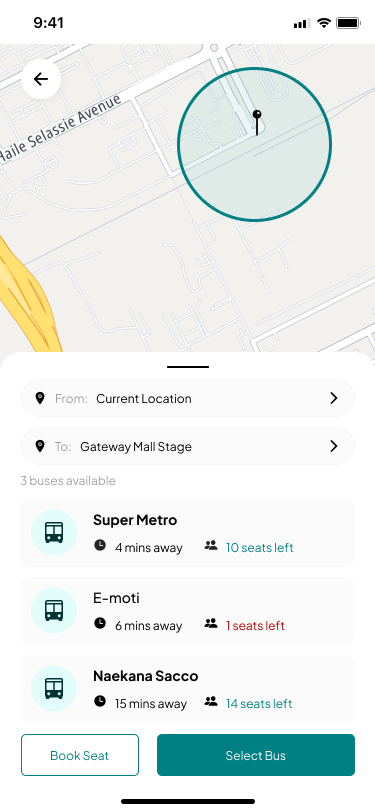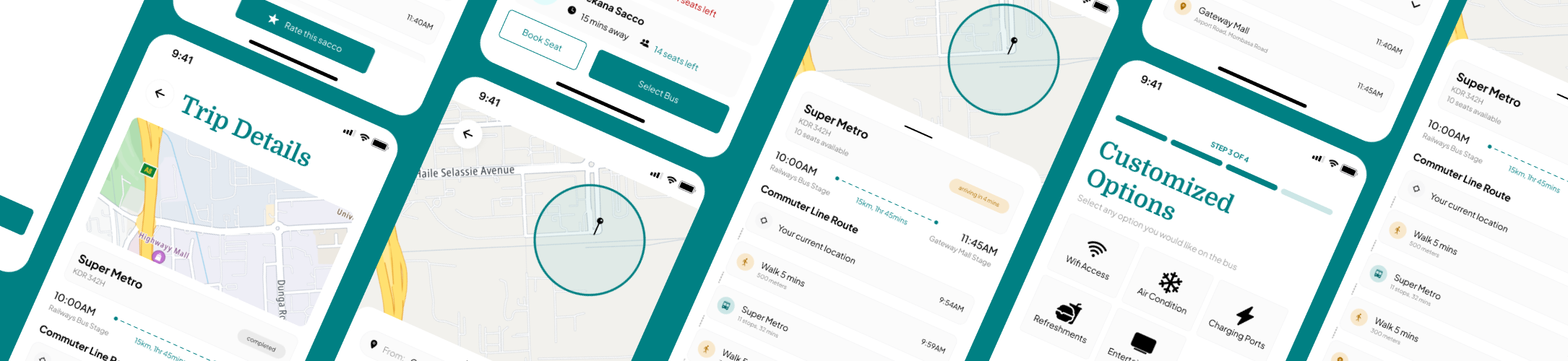
Overview
Bus travel in Kenya is still mostly booked by phone. Project Manara was built to change that.
Despite being one of the most-used forms of transport in Kenya, intercity
and corporate bus travel has had no reliable digital booking infrastructure.
SACCOs manage their fleets manually, commuters book through agents or phone calls,
and corporate organisations have no way to track or manage employee travel at scale.
Project Manara was designed to bridge that gap; a mobile-first booking platform for commuters
to search routes, select seats, and pay digitally. I designed the full product from zero, with
a specific focus on making the commuter booking experience fast, clear, and frictionless on a mobile device.
How do you bring the reliability and simplicity of digital booking to Kenyan bus travel for commuters who've only ever booked by phone?
The Challenge
A highly used service with no digital infrastructure
The status quo for bus travel in Kenya involves calling a SACCO office, asking about availability, being quoted a price, and paying cash at the stage. There's no confirmation, no seat selection, and no visibility into whether the bus will actually show up on time.
Booking was entirely manual
Commuters called offices or showed up in person with no way to check availability, compare routes, or confirm a seat without human intervention.
Cash-only payments
No digital payment meant no receipts, no refunds, and no record of transactions, creating friction and distrust on both sides.
No route visibility
Commuters had no way to compare routes, departure times, or prices across operators without calling each one individually.
Zero corporate tooling
Organisations managing employee travel had no dashboard, no policy controls, and no visibility into how travel budgets were being spent.
Design Process
Mapping the commuter journey end to end.
Starting from zero meant mapping the complete user journey before touching any UI, understanding every decision a commuter makes from the moment they need to travel to the moment they board.
01
Search
Origin, destination, date
02
Browse
Routes, times, prices
03
Select
Choose route & operator
04
Seat
Pick seat on bus map
05
Pay
M-Pesa / card
06
Confirm
Ticket & boarding pass
Key Design Decisions
Designing for the Kenyan commuter
The matching experience was designed to help clients find a therapist they'd actually feel comfortable with, not just the first available slot. Filters for specialisation, gender, language, and session format gave users agency without overwhelming them with choice.
Search & route discovery
- Location autocomplete with popular routes surfaced first: most commuters travel the same routes repeatedly. Nairobi→Mombasa, Nairobi→Kisumu show up before a user finishes typing.
- Results sorted by departure time by default: commuters are almost always time-sensitive. Price sorting is available but not the default view.
- Operator trust signals on each result: rating, total trips, and on-time percentage surfaced on the results card, not buried in a detail page.